

NIPS-CERN is glad to share the open-access publication of Convolutional Neural Networks for Signal Reconstruction in High-Energy Calorimetry in the journal Applied Sciences (MDPI). The paper comes out of a collaboration between the Polytechnic Institute of Rio de Janeiro State University (IPRJ/UERJ) and the UFJF, and is signed by Diogo Alves Cardinot, Bernardo Sotto-Maior Peralva, Gustavo Barbosa Libotte and Luciano Manhães de Andrade Filho.
A calorimeter is the part of a detector that stops particles and measures the energy they carry. Each of its cells answers a collision with a short electrical pulse, and the height of that pulse stands for the energy the particle left behind. Read that height accurately and the rest of the analysis holds; read it wrong and every quantity derived from it carries the error forward. The difficulty is that, at the collision rates of a machine like the LHC, pulses from separate collisions land on top of one another. That overlap, called pile-up, is the central problem this paper sets out to address.
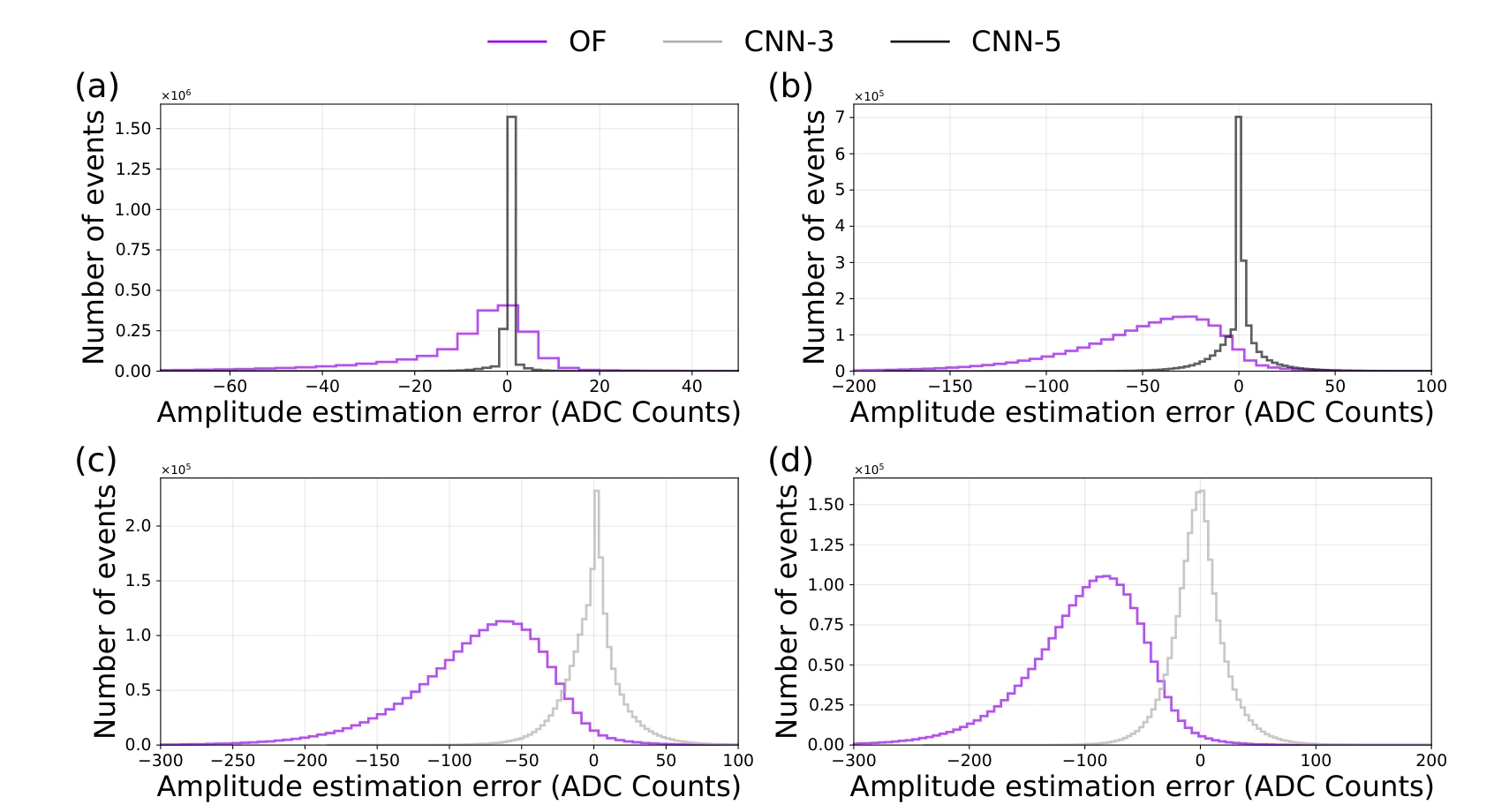
The standard tool for reading the pulse height is the Optimal Filter, a fast linear method that assumes a clean, isolated pulse and well-behaved noise. Those assumptions hold while the detector is quiet and fall apart as it gets busy. The authors placed the Optimal Filter side by side with several lightweight convolutional neural networks, the same family of pattern-finding models used in image recognition, and trained them on simulated calorimeter pulses at four levels of crowding: 10%, 50%, 80% and 100% cell occupancy.
The networks won at every level, and by wider margins as the crowding grew. Averaged over the four cases, they cut the amplitude error (RMS) by about 79% against the Optimal Filter and improved the timing estimate by roughly 26%. The sharpest result is at full occupancy: there the Optimal Filter does worse than simply guessing the average energy every time, while the neural network stays accurate. No single network was best everywhere, which the paper treats as a result in itself, with one architecture leading at low and medium occupancy and another under heavy pile-up.
Training the networks is expensive, around six hours per architecture against ten minutes for the Optimal Filter, but that cost falls entirely on the offline training stage. Once trained, a network reconstructs a pulse in a single pass, light enough to run on the FPGAs that read calorimeters out in real time. The study rests on a deliberately clean, single-channel simulation, without detector geometry, particle showers or cross-talk, and the authors are explicit that the next steps are a hardware implementation, more realistic simulations and, in time, real detector data. The full paper is open access. Read the paper.
Our congratulations to Diogo Alves Cardinot, Bernardo Sotto-Maior Peralva, Gustavo Barbosa Libotte and Luciano Manhães de Andrade Filho on this publication.
Reference: Appl. Sci. 2026, 16(13), 6414. DOI: 10.3390/app16136414.