

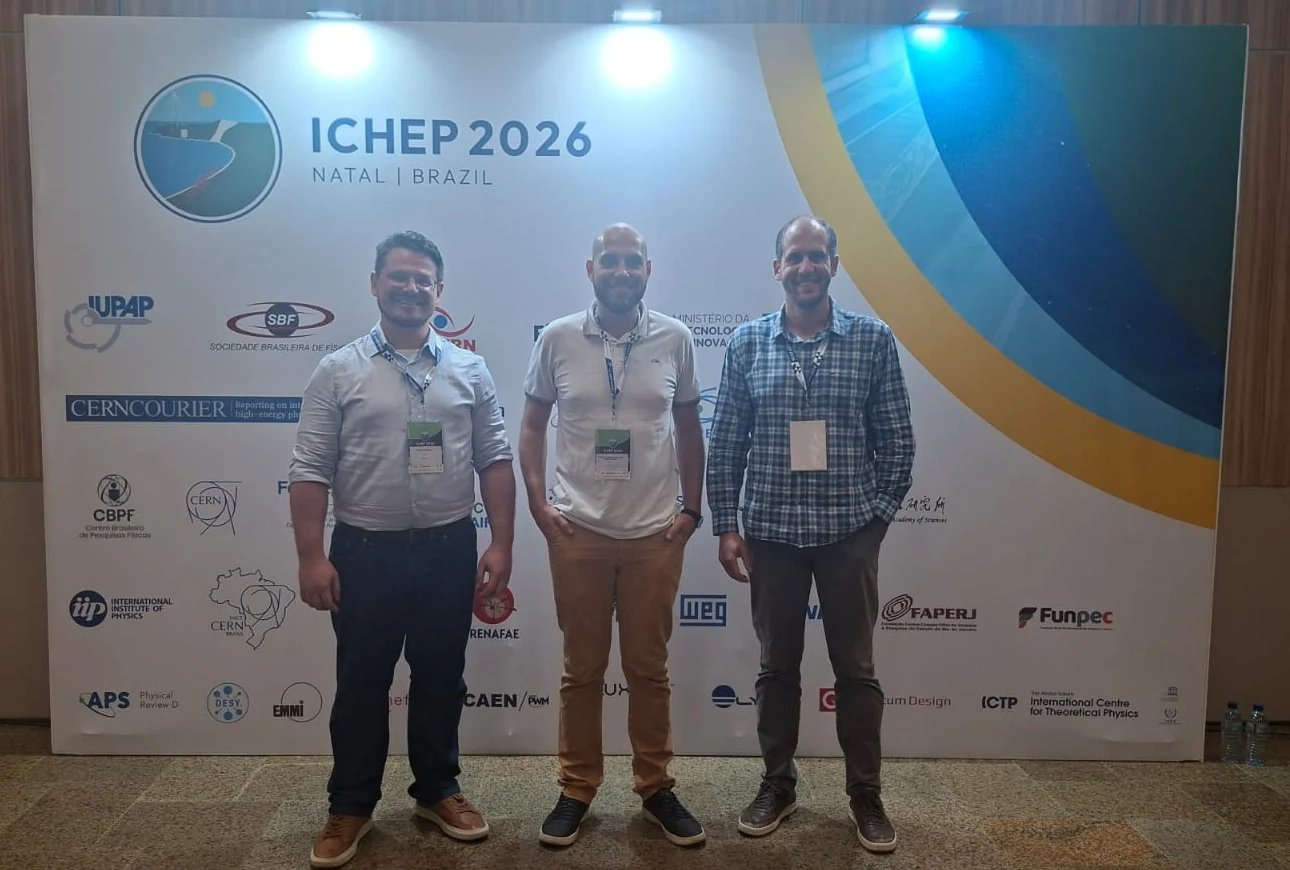
The International Conference on High Energy Physics (ICHEP) is the main general meeting of particle physics and is held every two years. The 43rd edition is taking place in Natal, Rio Grande do Norte, from 30 July to 5 August 2026.
In a collaboration the size of ATLAS, with thousands of members spread across dozens of countries, whoever speaks at a conference of this scale does not present the work of their own laboratory: they present the result of the entire experiment, selected and endorsed by the collaboration. That is why the speaker list of an ICHEP edition works as a portrait of who sits at the centre of the experiment's activities. In the first two days of the event, seven of those presentations went to researchers based at Brazilian institutions.
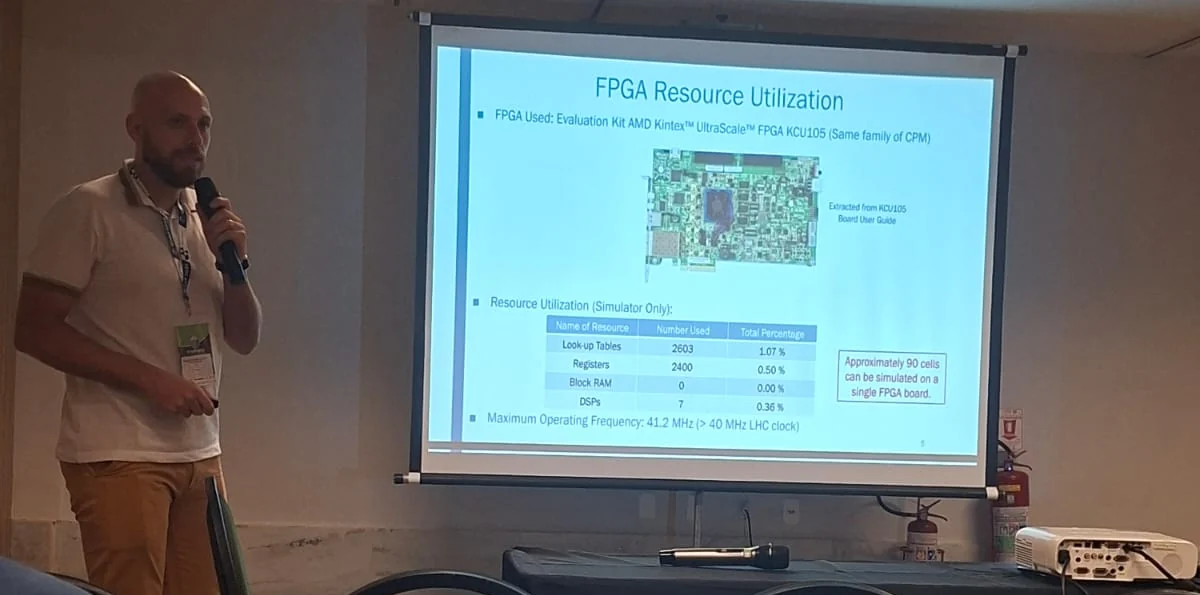
- Thiago C. A. Paschoalin (professor at CEFET-MG and postdoctoral researcher at NIPS-CERN, UFJF), with Real-Time Pulse Simulator of ATLAS Tile Calorimeter: an FPGA-based pulse simulator running at the LHC bunch-crossing frequency of 40 MHz, which emulates the full readout chain and sustains continuous data streams over long periods for systematic validation and stress testing of firmware.
- Tiago Quirino (UERJ), with Upgrade of ATLAS Hadronic Tile Calorimeter for the High Luminosity LHC: the complete replacement of the Tile Calorimeter electronics, on and off detector, to meet the 1 MHz trigger, the higher radiation levels and the pile-up of the high-luminosity phase.
- Gustavo Libotte (UERJ), with Tuning the Energy Reconstruction algorithm of ATLAS Tile Calorimeter: OF2 COV incorporates the noise covariance matrix into the filter weights and reduces the energy mean squared error by up to 25% compared with the standard OF2.
- Edmar Egídio Purcino de Souza (UFBA), with Experience with the ATLAS High Level Calorimeter Trigger Software in the LHC Run 3: the operational experience with the calorimeter algorithms of the high level trigger throughout Run 3.
- Edmar Egídio Purcino de Souza (UFBA), as a poster, with Run 3 E/gamma trigger performance: the design, optimisation and validation of the Run 3 electron and photon triggers.
- Eduardo Furtado de Simas Filho (UFBA), with Machine Learning Techniques for Electron and Photon Triggering in ATLAS: the use of machine learning at several stages of the electromagnetic trigger chain, from NeuralRinger to gradient-boosted-tree energy calibration in the FastCalo step.
- Marco Lisboa Leite (USP), with The ATLAS High-Granularity Timing Detector: project status and results: the status and results of the new high-granularity timing detector, which will give ATLAS the timing resolution needed to separate vertices in the high-luminosity phase.
The weight of the Brazilian contribution is concentrated in calorimetry and trigger systems, precisely the line in which the ATLAS/Brazil cluster has established itself within the experiment: six of the seven contributions deal with the Tile Calorimeter, with the energy reconstruction that feeds the trigger, or with the online selection of electrons and photons; the seventh, with the new high-granularity timing detector. Four institutions are represented: UFJF, UERJ, UFBA and USP.
For NIPS-CERN, the list carries an additional meaning. Tiago Quirino and Thiago Paschoalin did their doctorates in the group, supervised by Professor Luciano Manhaes de Andrade Filho. Quirino is now a professor at UERJ; Paschoalin is a professor at CEFET-MG and a postdoctoral researcher at NIPS-CERN.
Beyond the seven presentations given on behalf of ATLAS, ICHEP 2026 also hosted a Brazilian contribution of a different kind, with NIPS-CERN participation: New Features of the Lorenzetti Showers Framework, on the open simulation tool for showers in high-energy detectors, signed by sixteen authors from Brazilian and French institutions. Among them is the group's doctoral student Mateus Hufnagel, alongside the partners at LPNHE in Paris, with whom NIPS-CERN collaborates through the CAPES-COFECUB project.