

On 24 June 2026, in a public session at the Federal University of Juiz de Fora (UFJF), Prof. Dr. Luciano M. de Andrade Filho defended his academic memorial as a candidate for promotion to Class E, the rank of Full Professor. The session opened at 8:30, before a board presided over by Prof. Carlos Augusto Duque.
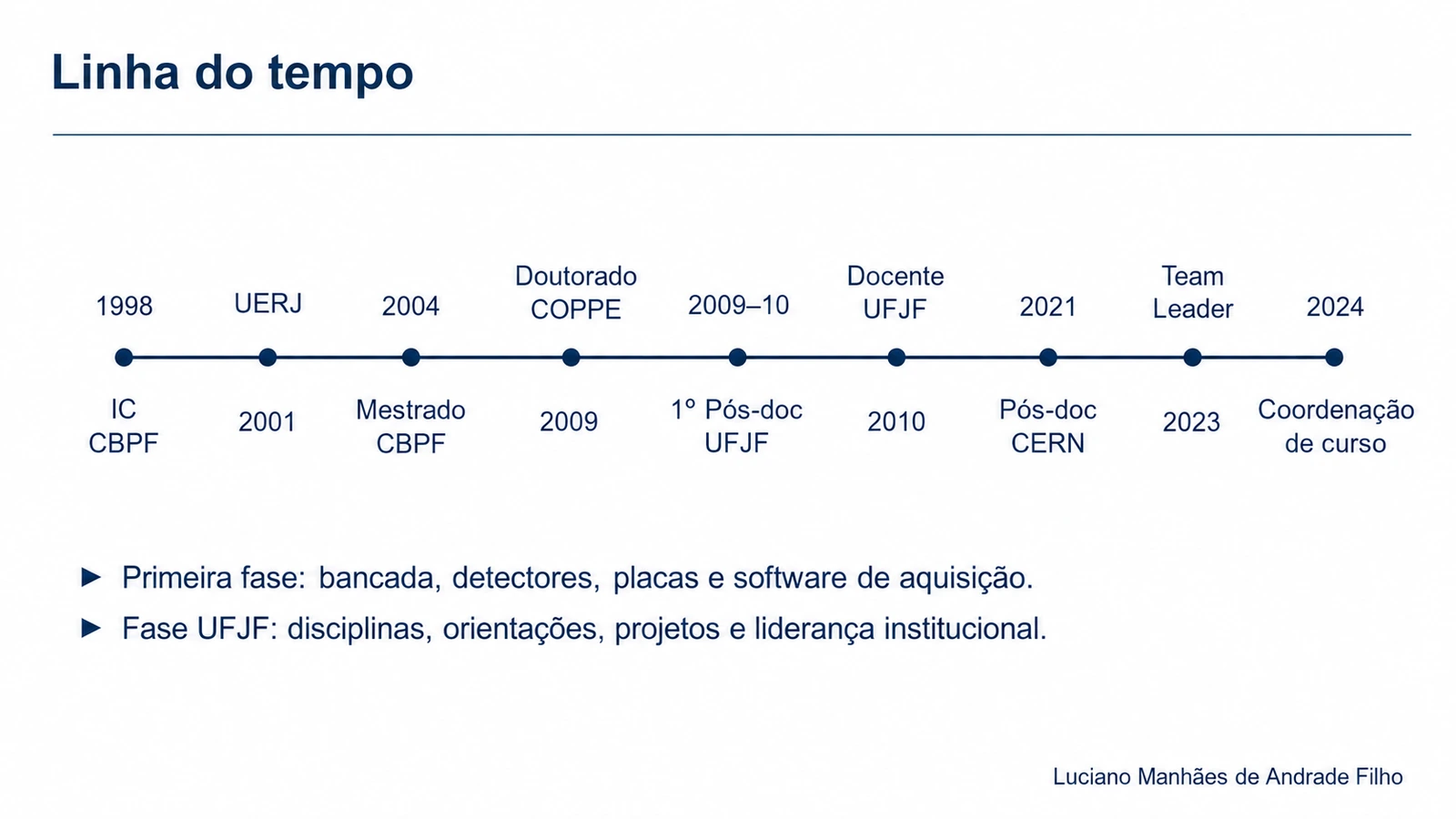
More than an examination, a memorial is an account of a life devoted to research, and the one Andrade Filho presented reaches back to 1998. It started with an undergraduate fellowship at the Brazilian Center for Physics Research (CBPF), on the Pierre Auger Observatory, the cosmic-ray experiment at Malargüe, in the Province of Mendoza, Argentina, and ran through a degree in Electrical Engineering at the Rio de Janeiro State University (UERJ) in 2001, a master's at the CBPF in 2004, and a doctorate in 2009 at COPPE (Coordenação dos Programas de Pós-Graduação em Engenharia), the engineering graduate institute of the Federal University of Rio de Janeiro (UFRJ), with a spell at the European Organization for Nuclear Research (CERN, from the French Conseil Européen pour la Recherche Nucléaire) along the way.
That same year a first postdoctoral programme brought him to the UFJF, where he joined the faculty in 2010 and has taught since. A second postdoc took him back to CERN in 2021; in 2023 he became the UFJF Team Leader in the ATLAS Collaboration, the particle-physics experiment at CERN, and in 2024 he took over the coordination of the Electrical Engineering – Electronic Systems course.
The questioning, thirty minutes for each examiner, moved across the breadth of that work: more than 1,300 journal articles, most of them within the ATLAS Collaboration, and projects built at the NIPS-CERN laboratory (Center for Instrumentation and Signal Processing), among them SAPHO, the CGVWeb event display (a browser version of the Calorimeter Geometry Viewer), and AURORA. He answered all of it masterfully.
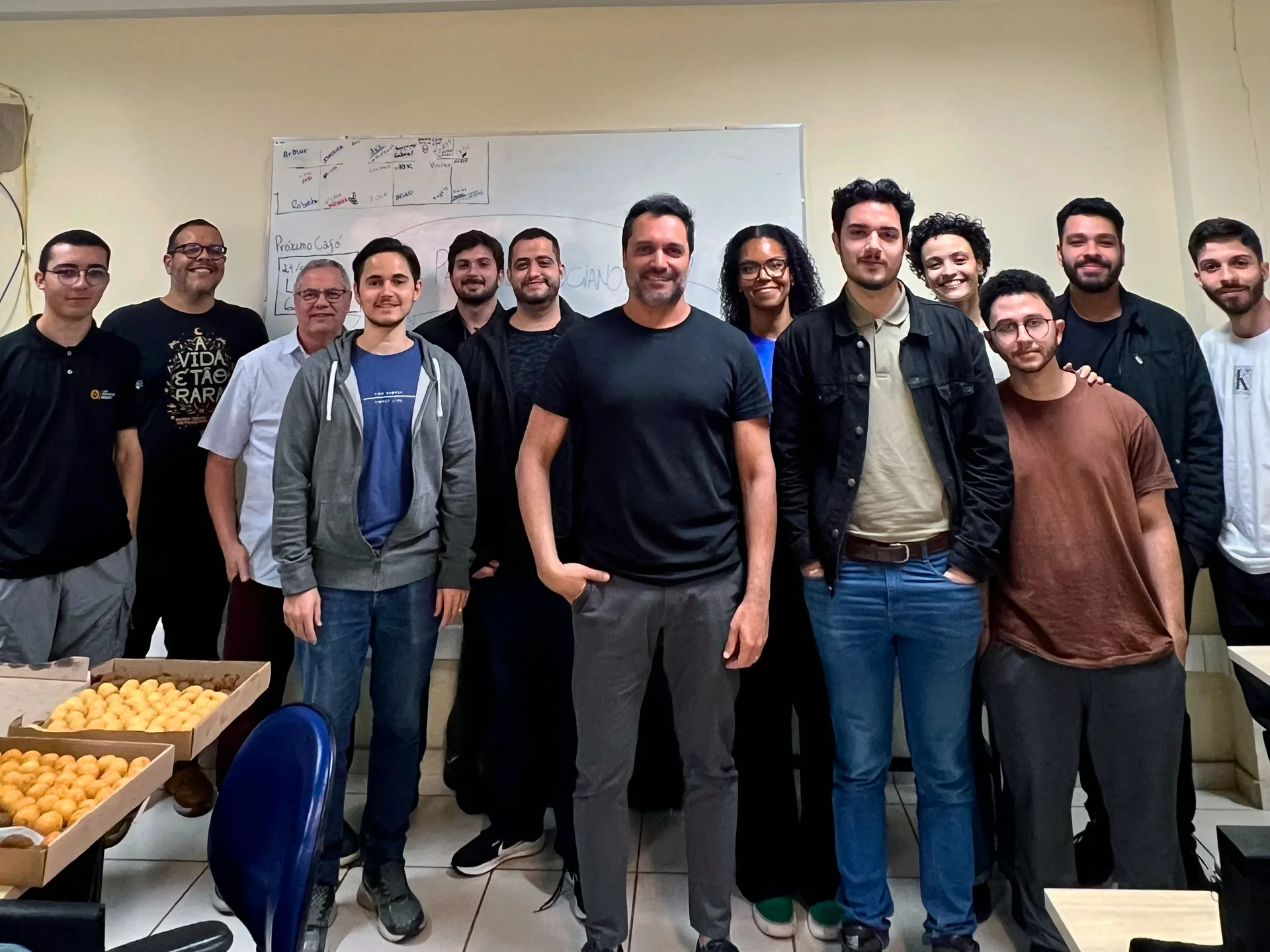
At 16:00 the traditional Wednesday afternoon coffee gave way to a party. The group gathered at the laboratory itself, in the building of the Graduate Program in Electrical Engineering (PPEE), around a cake, with food and drinks and the easy warmth of people who had shared years of the work. The cover photograph is from that gathering, with members of NIPS and NIPS-CERN.