

We are delighted to celebrate another achievement from within the NIPS-CERN community. Chrysthofer, an undergraduate student at UFJF affiliated with NIPS-CERN, received a distinguished prize at SEMIC 2025, the Seminário de Iniciação Científica of the Universidade Federal de Juiz de Fora, which brings together undergraduate research from across the university's two campuses.
His awarded work presents a soft-core processor that generates the Mandelbrot set fractal, designed entirely with NIPS-CERN's SAPHO toolchain (Scalable-Architecture Processor for Hardware Optimization). SAPHO targets FPGA hardware, and the processor was validated in simulation, where it drew the set correctly. Carrying it onto a physical FPGA is the natural next step, and the result already shows the practical reach of our architecture and compiler ecosystem.
The accompanying video shows the fractal geometry emerging on screen as the processor computes the set pixel by pixel, driven by CMM programs compiled with YANC within the SAPHO environment. The video resonated with the scientific computing community, accumulating over 4,000 views, more than 1,000 likes, and 500 comments.
The work behind the video was also set down in a paper accepted at the XXVIII Encontro Nacional de Modelagem Computacional (ENMC 2025), Implementação de Fractal em FPGA Usando o Processador Soft-Core SAPHO, with Chrysthofer among the authors.
The fractal was never only an aesthetic exercise. Behind it lies a question Chrysthofer and Luciano have been working on for some time: whether the mathematics of fractals, self-similarity and invariance across scales, can be carried into the physics of the particle collisions studied at CERN. The link is not merely visual. When a quark emits a gluon inside a high-energy collision, the process repeats at smaller and smaller scales in a branching pattern, and physicists at the CMS experiment describe the result as a fractal tree of quarks and gluons, reconstructed from the jets the detector records.
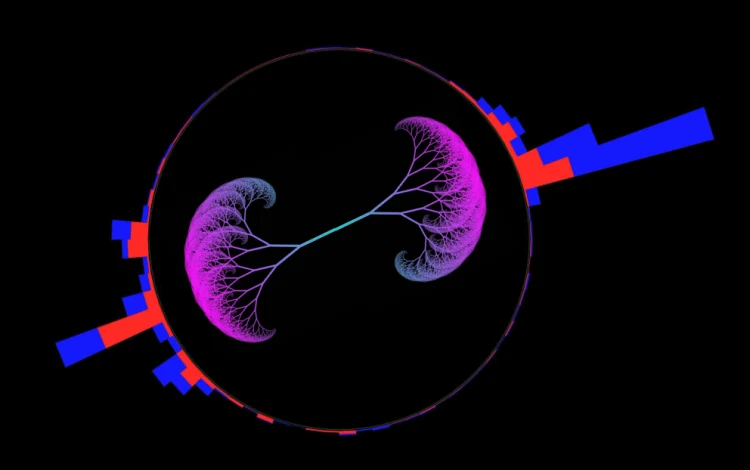
Seen this way, the recursion that draws the Mandelbrot set and the branching that organises the spray of a proton collision are two faces of the same geometry. Bringing that framework from pure mathematics into experimental particle physics is one of the directions the group has set out to explore.
This work sits at the intersection of scientific computing, hardware design, and mathematical visualisation: three pillars of research at NIPS-CERN. We congratulate Chrysthofer on this well-deserved recognition and look forward to seeing more of his work.
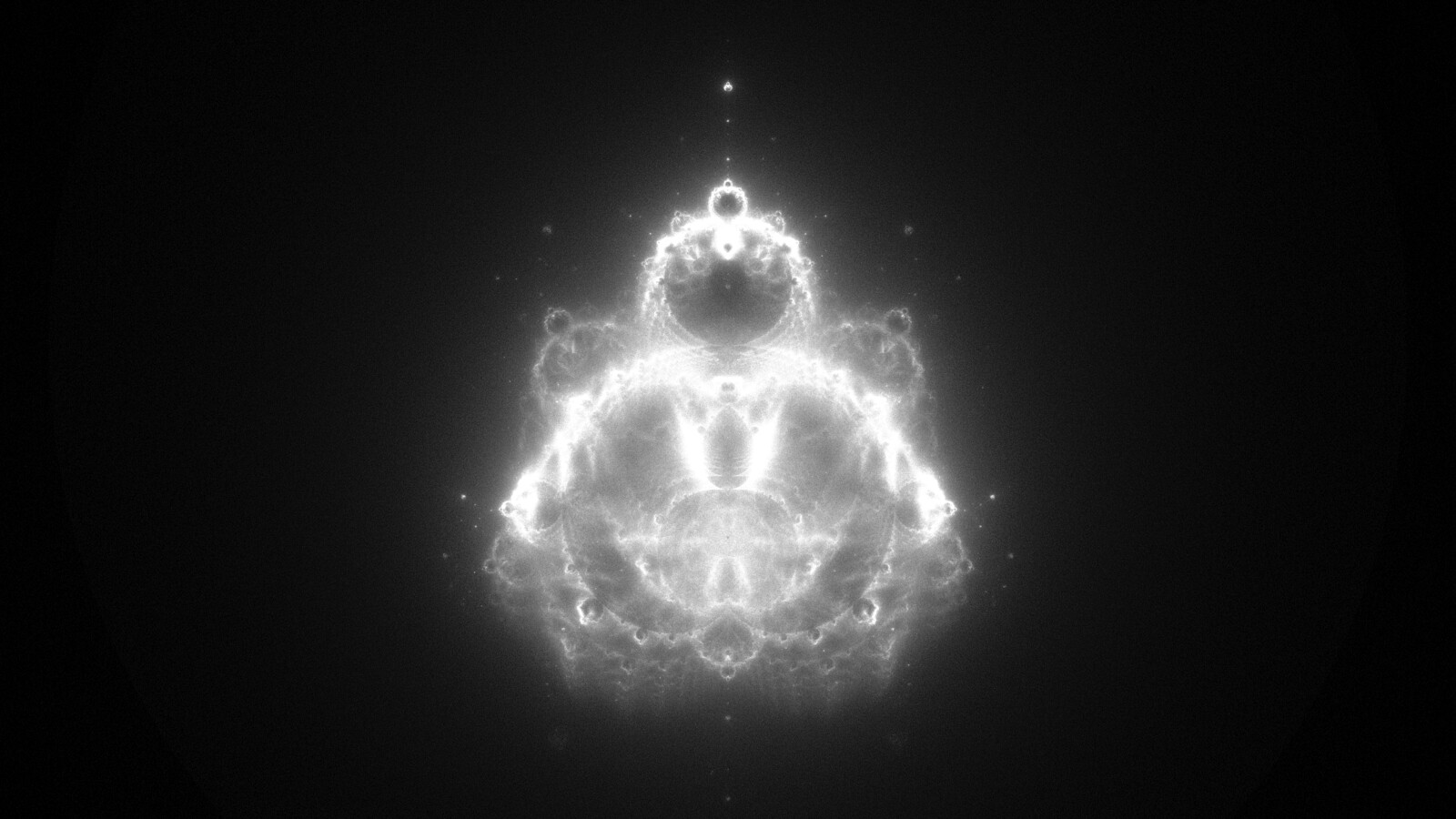
About the cover: the image at the top of this article is a Buddhabrot, a probability-density rendering of the Mandelbrot set, computed with SAPHO by the authors, for anyone who cares to look it up.
Note: NIPS-CERN's Dr. Luciano Manhães de Andrade Filho was also recently awarded the 2025 Breakthrough Prize in Fundamental Physics as a member of the ATLAS Collaboration at CERN, marking a year of exceptional recognition for the laboratory.